
Face Anti-Spoofing
A deep learning classification model built with Vision Transformer (ViT) and PyTorch to distinguish live faces from spoof attacks. The project explores image preprocessing, model architecture, training, and evaluation using the CelebA-Spoof dataset.
Project Overview
Face anti-spoofing is a computer vision task that determines whether a face presented to a camera belongs to a real person or comes from a spoofing attack. This project uses a pretrained Vision Transformer backbone as a feature extractor, followed by a custom multilayer perceptron classifier for binary classification.
Architecture
Vision Transformer
Input Resolution
224 × 224
Output Classes
Live / Spoof
Framework
PyTorch
Model Architecture
The model consists of a pretrained ViT backbone and a custom classification head. The backbone extracts high-level visual representations, while the classifier maps the extracted features into two output logits.
Input Image
224 × 224 RGB
Vision Transformer
Pretrained ViT Feature Extractor
LayerNorm
Feature Normalization
Dropout
Regularization
Linear → GELU
Feature Projection · 512
Dropout → Linear
Binary Classification
Live
Binary Class
Spoof
Binary Class
Dataset
The model is trained and evaluated using the Ar4ikov/celebA_spoof dataset hosted on Hugging Face. It contains face images labeled as live or spoof for face anti-spoofing classification.
from datasets import load_dataset

ds = load_dataset("Ar4ikov/celebA_spoof")
Dataset Split
| Split | Available | Used |
|---|---|---|
| Train | 419,935 | 419,935 |
| Test | 59,191 | 10,000 |
Test Set Distribution
Live samples
2,774
27.74% of test set
Spoof samples
7,226
72.26% of test set
Preprocessing
- • Resize input images to 224 × 224 pixels.
- • Apply preprocessing required by the ViT backbone.
- • Convert images into tensors for PyTorch inference.
The complete training split was used for training. For evaluation, 10,000 samples were randomly selected from the original test split of 59,191 samples.
Model Weights
The trained model checkpoint is available on Google Drive. Download the model.pth file to use the trained weights with the corresponding model architecture and configuration.
model.pth
PyTorch model checkpoint
Checkpoint Usage
import torch

checkpoint = torch.load(
    "model.pth",
    map_location="cpu",
    weights_only=True
)

model.load_state_dict(checkpoint)
model.eval()
The loading example assumes model.pth contains a state dictionary. If the checkpoint uses a wrapper dictionary, load the corresponding state_dict entry instead. Make sure the model architecture and configuration match the training setup.
Evaluation Results
The model was evaluated on 10,000 test samples using classification metrics and threshold-independent evaluation.
Accuracy
60.73%
ROC-AUC
0.7513
Precision
39.94%
Recall
82.48%
Specificity
52.38%
F1 Score
53.82%
EER
32.19%
FAR
47.62%
The model achieved 60.73% accuracy and a ROC-AUC of 0.7513. Its recall of 82.48% indicates that a substantial proportion of positive-class samples were detected. However, the false acceptance rate of 47.62% highlights the need for further threshold calibration and validation.
Confusion Matrix
The confusion matrix shows the number of correctly and incorrectly classified samples for each class.
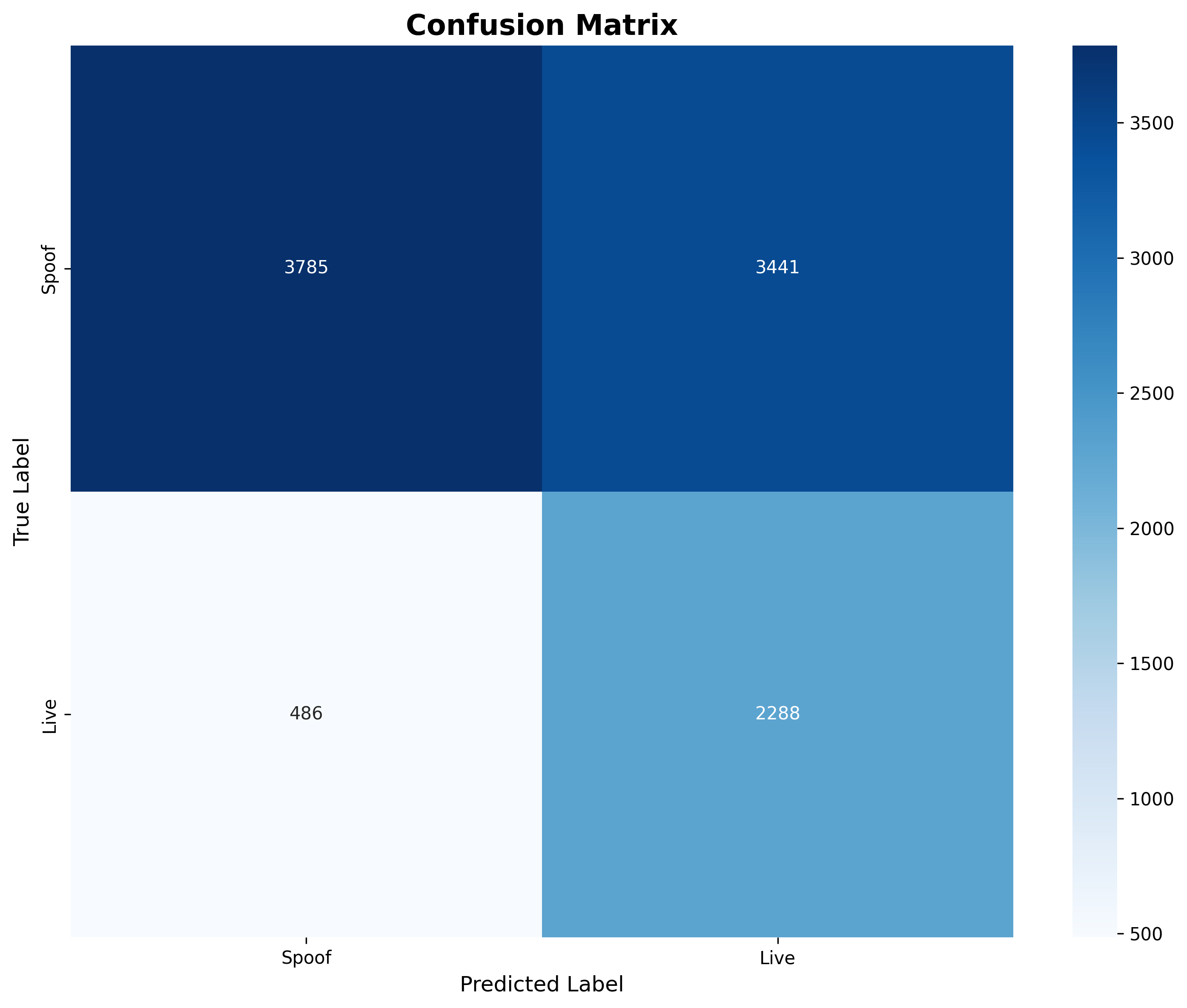
| Actual / Predicted | Live | Spoof |
|---|---|---|
| Live | 2,288 | 486 |
| Spoof | 3,441 | 3,785 |
Example Predictions
Selected test samples with their ground-truth labels, predicted classes, and Live class probabilities. These examples provide a closer look at how the model classifies individual face images, including correct predictions and misclassifications.
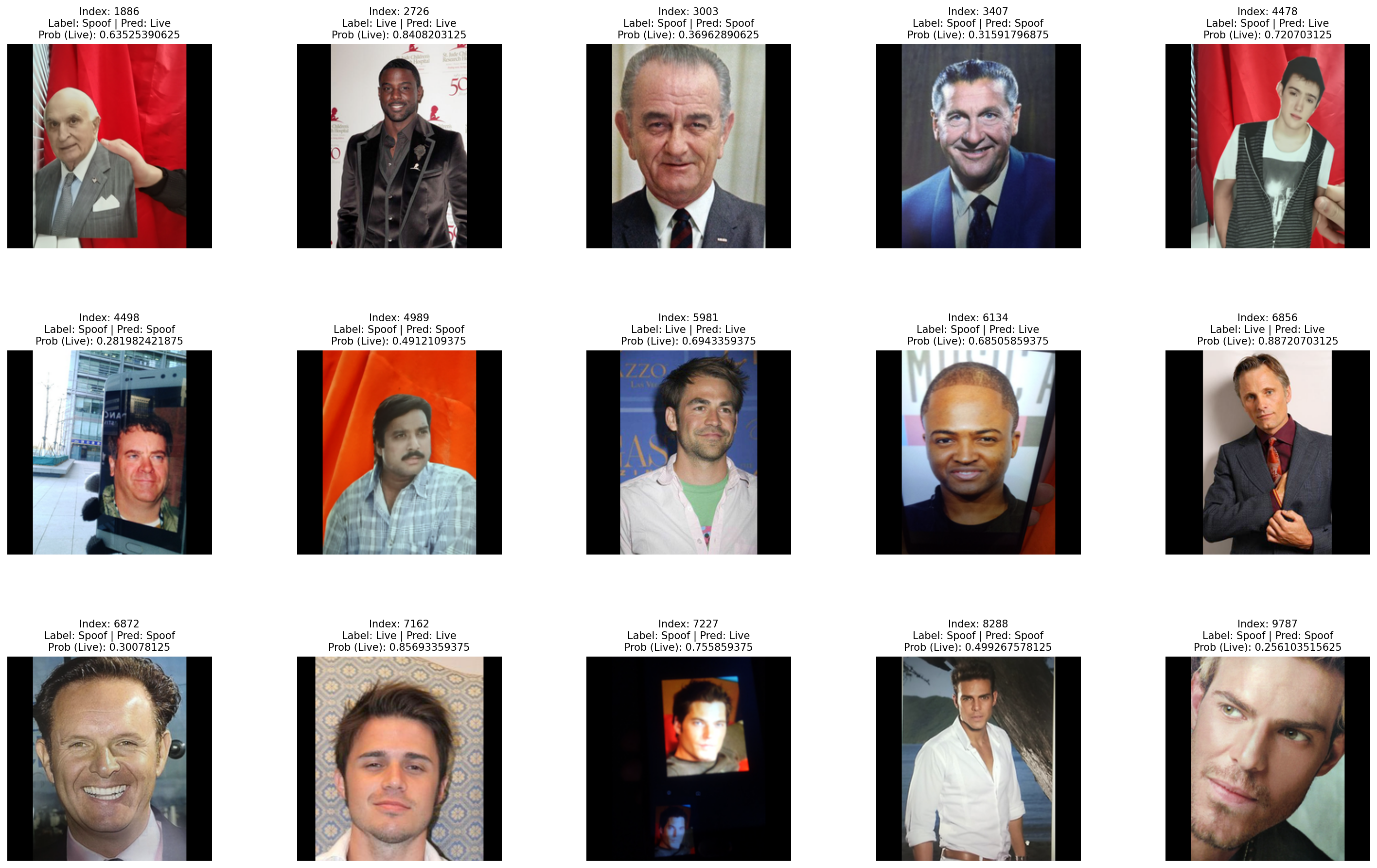
Input Image
Individual face images from the test dataset.
Ground Truth & Prediction
Actual dataset labels compared with model predictions.
Live Probability
Model output probability for the Live class, useful for examining prediction confidence.
ROC Curve
The Receiver Operating Characteristic (ROC) curve illustrates the relationship between the true positive rate and false positive rate across different classification thresholds. The Area Under the Curve (AUC) provides an overall measure of the model's ability to distinguish between classes.
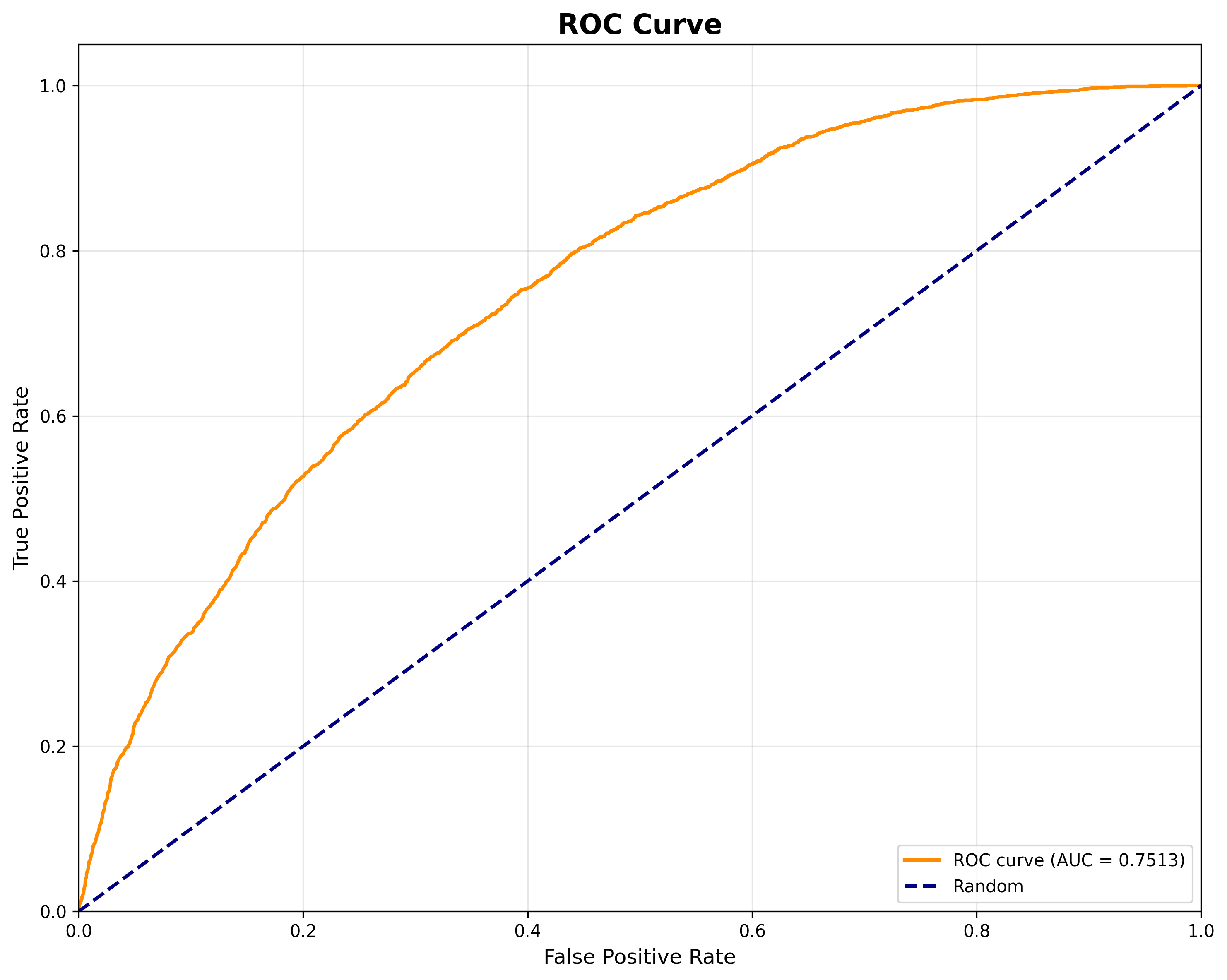
ROC-AUC Score
0.7513
Indicates discriminatory ability beyond random classification, while leaving room for improvement.
Limitations & Future Work
Limitations
- • Evaluation uses only 10,000 of 59,191 test samples.
- • The test dataset has an imbalanced class distribution.
- • The false acceptance rate remains relatively high.
- • Generalization to unseen spoof attacks and real-world capture conditions has not been established.
Future Improvements
- • Evaluate on the complete test split.
- • Investigate class imbalance and threshold calibration.
- • Analyze false-positive and false-negative samples.
- • Evaluate generalization across spoof attack types.
- • Optimize inference latency and memory usage.
Source Code
Explore the complete implementation, including data preparation, model architecture, dataset and dataloader, training, and evaluation notebooks.
github.com/ridwanFatur/spoof-detection↗